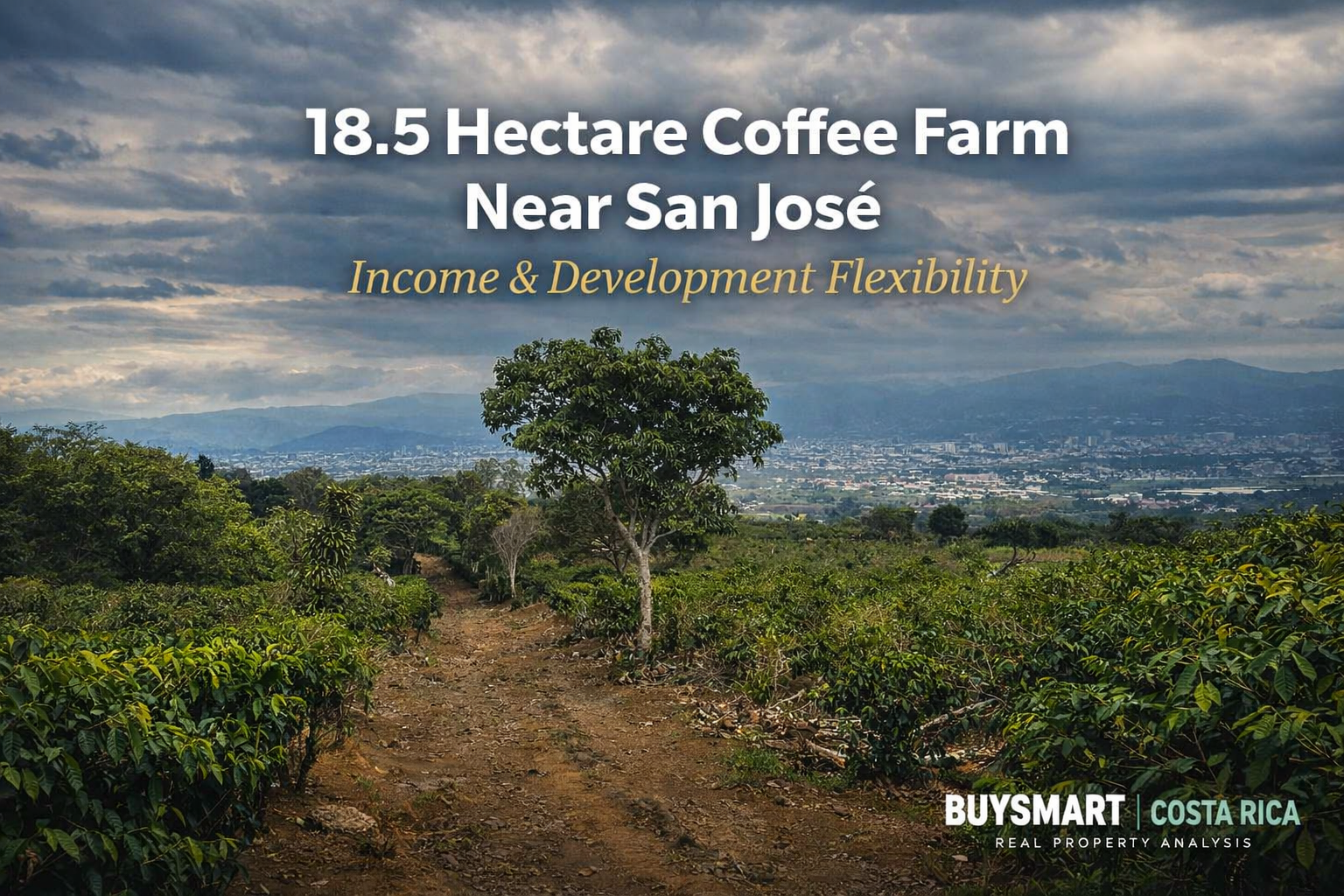
18.5 Hectare Coffee Farm — Favorable Zoning, Real Potential. Risks negative exploitation.

Most Buyers Walk Away From This $2.85M Costa Rica Farm…
Without Realizing They Could Enter for Under $1M
AND save it from Exploitive & HUGE Sterile projects.
Most buyers walk away from this deal for one simple reason.
They assume they have to buy all of it.
At a $2.85M price point, that’s an easy decision.
Too big. Too heavy. Move on.
And when they do, the only buyers left are the ones looking to maximize return.
That usually leads to one outcome.
High-density development.
Fast build.
Maximum extraction.
And once that happens… it doesn’t go back.
We see this all the time with larger land in Costa Rica.
Buyers focus on price first — instead of structure, use, and what the land actually allows.
Once land like this is pushed into high-density development, the opportunity for a more thoughtful and responsible use is gone permanently.
The Reality Most People Miss
On paper, this looks like a strong property.
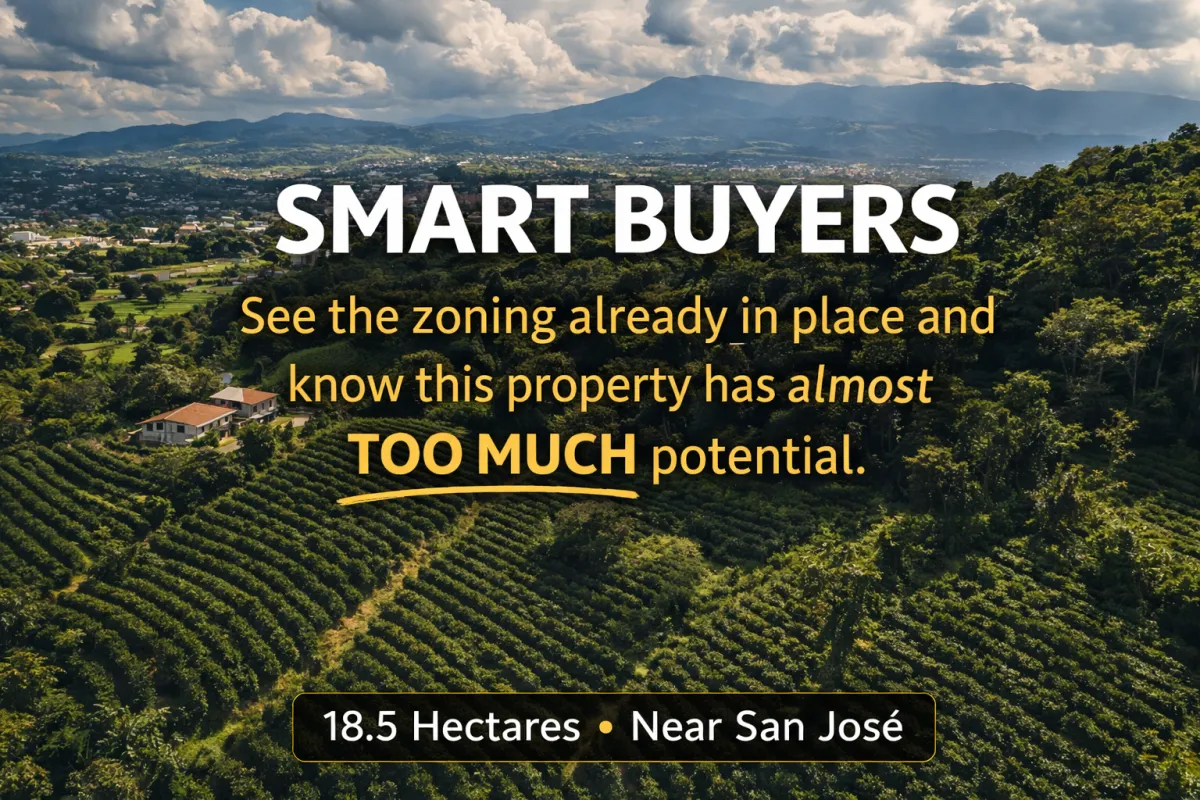
18.5 hectares above Heredia.
Commercial zoning.
Close to San José.
Existing income (~$120K/year).
It has scale.
It has access.
It has flexibility.
But that’s not what makes it interesting.
What matters is how it’s approached.
Because most buyers are solving the wrong problem.
They’re asking:
“Can I afford this?”
Instead of:
“How should this be structured?”
Property Snapshot
List Price: $2,850,000
Expected Sale Price: $2.6M – $2.8M
Estimated Days on Market: 90–180 days
Total Size: 18.5 hectares
Structure: 3 titled parcels (~6 hectares each approx.)
Estimated Parcel Entry: ~$850K – $1.1M
Location: Concepción de San Rafael, Heredia
Zoning: Commercial (up to 70% coverage)
Current Use: Coffee production (~$120,000/year)
Amenities: 30 Min to San Jose and the international airport. Up in the mountains overlooking the valley. Close to everything but surrounded by estates, farms and nature.
Suggested Use: Thoughtful eco development. Medium density with ample common areas, self sustaining infrastructure and community water/food production.
Want us to break down a property like this for you?
We analyze land based on what it actually supports — not just what it looks like.
The Core Problem
At this level, most buyers make one of two mistakes.
They either walk away because of the price…
Or they try to take on the entire project without a clear plan.
Both lead to the same result.
Missed opportunity.
Or a deal that quietly underperforms.
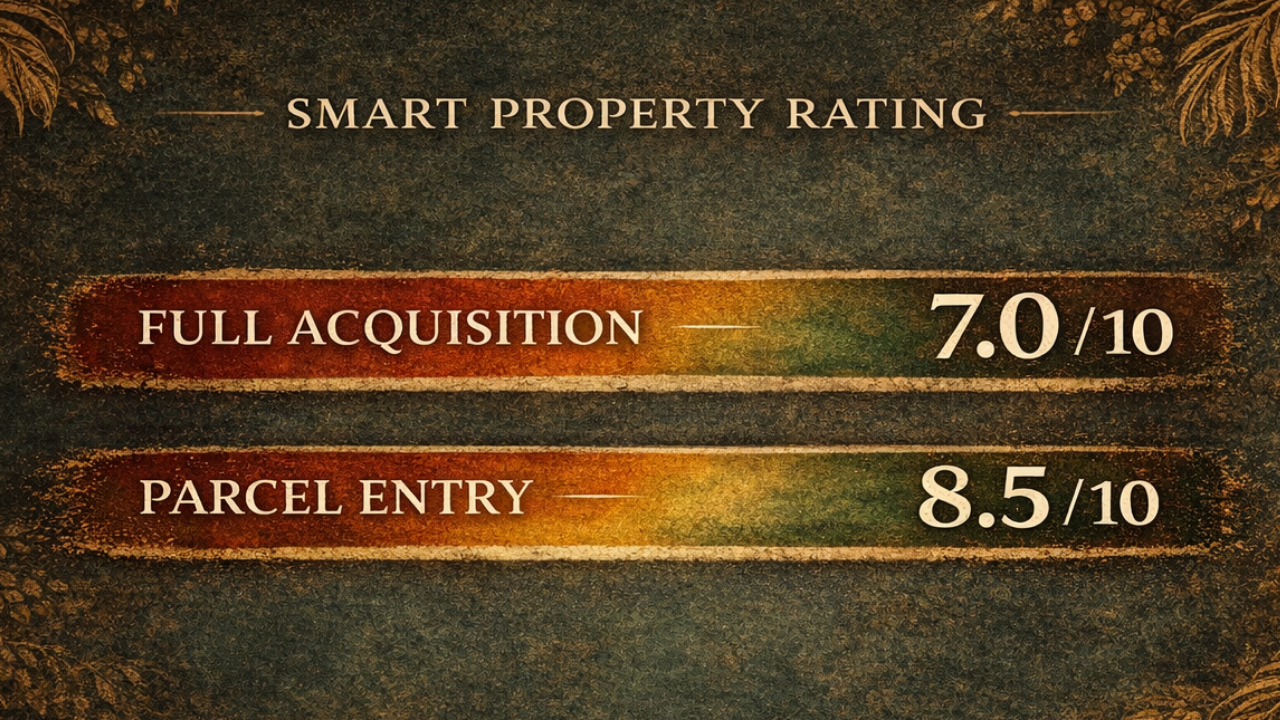
Why This Is a 7.0/10 Deal (For Most Buyers)
At full scale, this is not a bad deal.
But it’s not a great one either.
It requires:
Capital.
Coordination.
Execution.
And without all three, the flexibility of the land becomes risk.
There’s still reliance on external systems.
The current use is too simple to justify the price.
And development at this scale is easy to get wrong.
That’s how good properties turn into average outcomes.
The Shift Most Buyers Never See
This is not one deal.
It’s two.
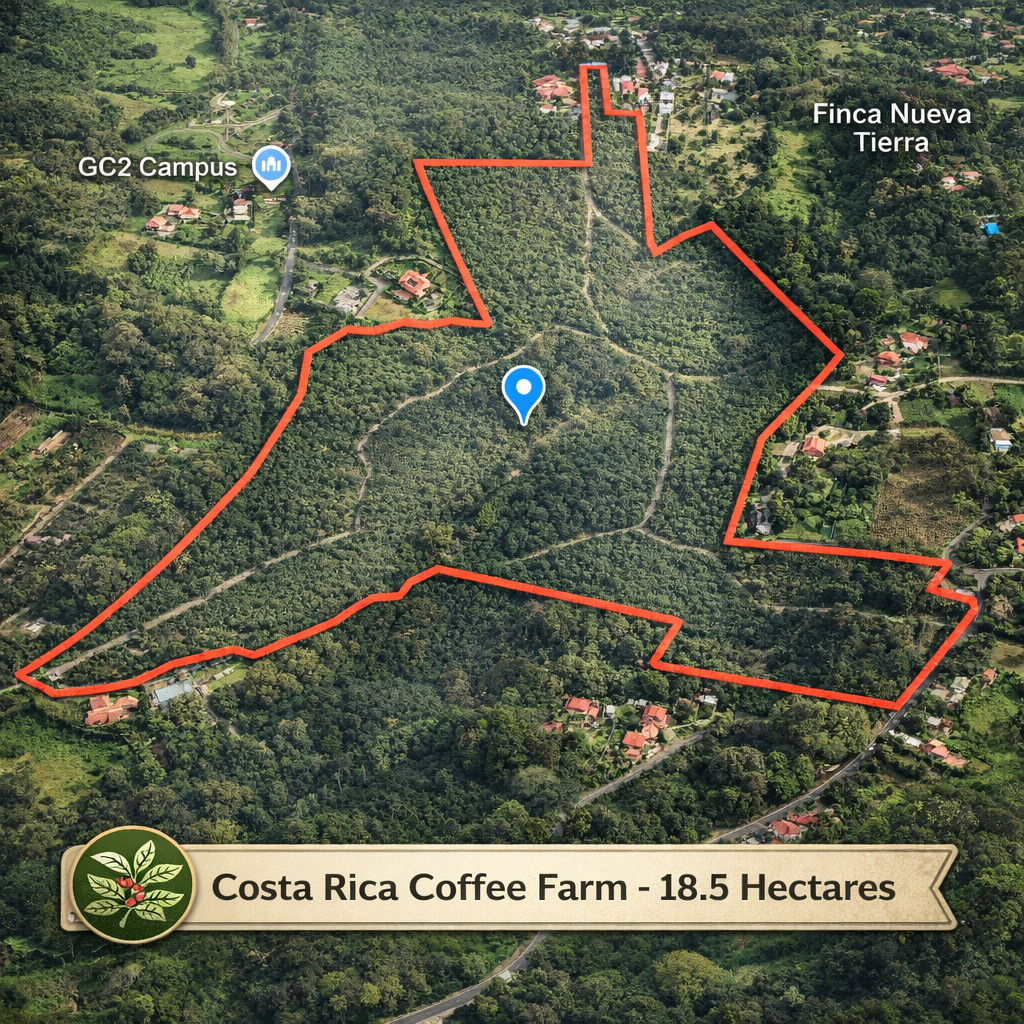
The property is already divided into three separate titled parcels.
Which means you don’t need to approach it as a single acquisition.
The Actual Opportunity
The smarter move here isn’t buying 18.5 hectares.
It’s stepping in at the parcel level.
~6 hectares.
Same zoning.
Same location.
Same upside.
Different risk.
Different capital requirement.
Different outcome.
That’s the move.
This isn’t a $2.85M decision.
It’s potentially a ~$900K entry into the same underlying asset.
And in some cases, with the right structure—financing, partnerships, phased entry—you can control a position here with significantly less upfront capital.
Most people don’t miss this deal because they can’t afford it.
They miss it because they don’t know how to approach it.
This is where most buyers get it wrong.
If you’re looking at land in Costa Rica, don’t guess your way through it.
Why That Changes Everything
At the parcel level, everything becomes more manageable.
Execution becomes realistic.
Financing becomes easier.
Risk compresses.
You can build in phases instead of forcing a full project upfront.
You can test, adapt, and scale properly.
And most importantly—you open this up to a completely different type of buyer.
Not just developers.
But builders. Operators. Groups.
People who actually want to create something meaningful—not just maximize density.
The Bigger Risk (And Why This Matters)
If the right buyer doesn’t step in, this property won’t sit still.
It will get developed.
High density.
Fast timeline.
Return-driven.
That path works financially.
But this land deserves something better.
It deserves a smaller, more intentional buyer-builder.
Someone who restores the land into a more natural system—while integrating living and business properly.
Not a sterile development.
Not another extractive project.
This is land that should be worked with—not overbuilt.
And whether that happens depends entirely on who sees the opportunity first.
The SMART Breakdown (Simplified)
When you actually break this down, you’re looking at two different outcomes depending on how you enter.
Full Parcel (18.5 Ha): ~7.0/10
Parcel Entry (~6 Ha): ~8.5/10 (when structured properly)
Sustainable — 6/10 → 7.5/10
The land works, but it’s not resilient yet. It relies on external systems and a single-use model. With proper development—water, energy, mixed-use layers—this improves significantly.
Mindful — 6.5/10 → 8/10
At full scale, mistakes are expensive. Most buyers overbuild or misplan. At the parcel level, you can phase properly and avoid locking in bad decisions.
Aligned — 8.5/10
This is where the property stands out. Strong location, real access, and zoning that supports actual use—not speculation.
Responsible — 7/10 → 8/10
The zoning gives power—but also risk. Full-scale pushes toward high-density outcomes. Smaller entry allows for more intentional development.
Tested — 7/10
The existing income provides runway—but doesn’t justify the purchase. This is not an income deal. It’s a platform.
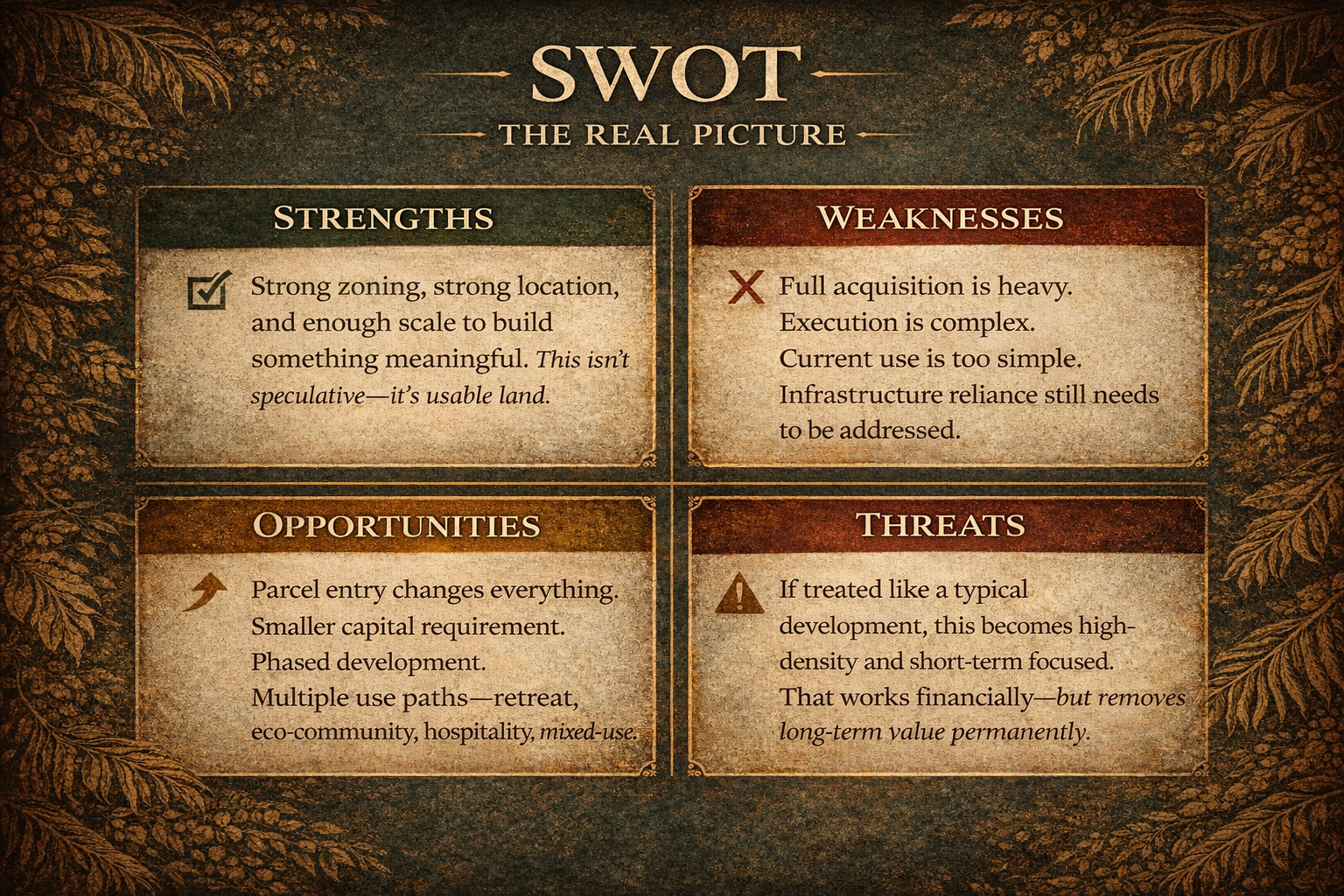
SWOT — The Real Picture
Before you decide what this property is, you need to see it clearly. Not the listing version, not the upside—just the asset as it stands today, with its strengths, its limits, and where the real opportunity actually sits depending on how you approach it.
What This Property Actually Is
This is not:
a passive investment
a simple farm
a lifestyle purchase
This is a decision point.
Handled one way, it becomes a high-density, return-driven development.
Handled another, it becomes a layered, long-term asset that produces income while improving the land.
The land doesn’t decide that.
👉 The buyer does.
Before You Commit to Any Property in Costa Rica
Most people don’t lose money because the property was bad.
They lose money because they misunderstood it.
We break properties down so you know:
what works
what doesn’t
what it actually supports
👉 [Request a SMART Property Assessment]
Who This Is Actually For
This works if:
You understand phased development
You’re open to structuring entry (not all-in)
You want to build something over time
This doesn’t work if:
You want a turnkey investment
You’re guessing your way through development
You’re forcing a small vision onto a large asset
Final Thought
This deal doesn’t change. The way you enter it does.
Most people don’t lose money because the property was bad. They lose money because they misunderstood what they bought.
The best properties don’t just produce income.
They give you options. This one does.
And if you approach it the right way, it's less risky with a much higher return.
Dustin Pritchard
Broker BUYSMART Costa Rica
Founder Alma Libre Sanctuary Project